

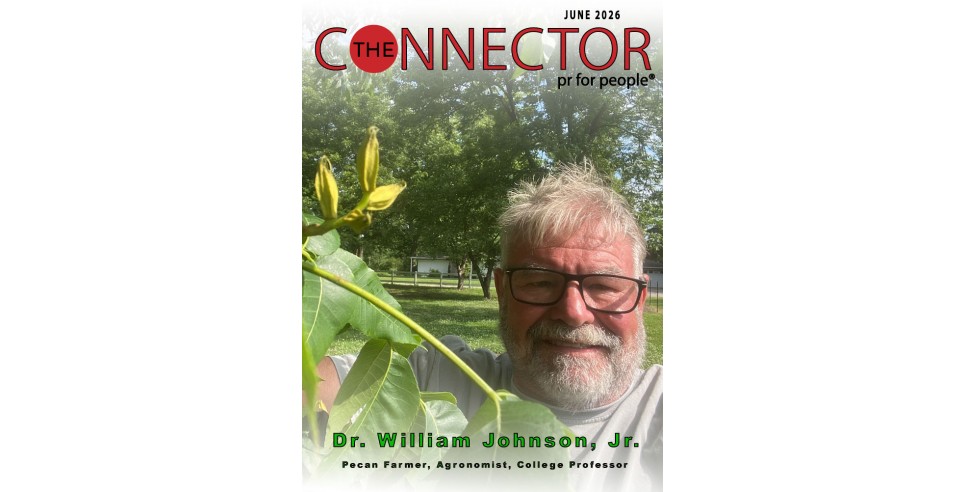
Jobs and work have always been our key topics for June. While everyone is hellbent on talking about A-I and technology, we need to keep in mind that traditional career opportunities abound and offer deep job satisfaction. Barbara Lloyd McMichael writes about a farmer who owns Johnson Pecan Farms in Beebe, Arkansas. Dr. William Johnson, Jr. is growing crops and cultivating farmers for the next generation. As a longtime farmer on a farm that has been associated with his family for generations, he knows the challenges firsthand. My Friend Sue is an essay about a wonderful friend. I’m astonished that the things we did as little kids predicted who we would become as adults. I think we might have been acorns. A theory about acorns asserts who we are destined to become is imprinted on our souls from the first moment of our lives. Robin Lindley interviewed renowned Professor Doug Underwood, who has recently launched his debut novel, Always Tessie, a Tale of the Turbulent 1960s that is set in the Pacific Northwest. Robin Lindley also interviewed Australian Director Anthony Maras about his new film “Pressure” that captures the intense planning for D-Day immediately before the invasion during World War II. Please see the entire interview that was originally published in the Hollywood Progressive. ––Patricia Vaccarino
Growing Crops and Cultivating Farmers by Barbara Lloyd McMichael By his affable manner and down-home speech, you might not figure the man for a college professor and prominent agronomist. But you’d be underestimating Dr. William Johnson, Jr. By the time Johnson was 15, he’d become a member of Future Farmers of America. He earned his bachelor’s and master’s degrees in agronomy at Arkansas State University-Jonesboro. At first he was taking 16 hours a semester while also working 40 hours a week at a steakhouse to pay his way through college, and in 1995 he received his PhD from the University of Arkansas. On his own farm, the legacy property of his ancestors, Johnson is growing 300 tomato plants of multiple varieties this year, along with a couple dozen jalapeño pepper plants, and a limited crop of okra. And then, of course there are the pecans…
My Friend Sue by Patricia Vaccarino Sue was my closest childhood friend. We were Yonkers kids, working-class, playing street games: kickball, basketball, football. We swapped books. It became a competition to see who would finish first. Our love of learning manifested itself in very different ways. Sue collected rocks, fossils and bugs. I wrote stories and poetry. Together we put on carnivals, posted flyers everywhere and charged all the other kids admission. I’m astonished that the things we did as little kids predicted who we would become as adults.
Robin Lindley Interviews Professor Doug Underwood A Third Act: At Last, Renowned Professor Doug Underwood Launches His Debut Novel, "Always, Tessie,” a Tale of the Turbulent 1960s Set in the Pacific Northwest. In Always, Tessie, Professor Underwood relates the story of young lovers Tessie and Derek who live in a Portland, Oregon suburb during the turbulent 1960s.
Fair Taxation Doesn’t Send Millionaires Fleeing Cities or States by Nick J. Licata
Sociologist Gregory D. Squires argues that it’s a myth that taxes drive millionaires to flee cities and states that tax them. An abridgment of Squire’s Baltimore Sun commentary, from Monday, January 26, 2026, forms the second half of this piece, where he provides empirical evidence that this belief is false. I believe it is false because many of the wealthy recognize that they need to be taxed, fairly, of course, to sustain a livable economic and social environment for all.
Annie Searle writes about security best practices, the Secret Service, and heightened security threats as the wars in Ukraine, Iran-Israel-Lebanon continue, and then there is talk of moving on Cuba.
Book Review: The Crowded Shroud by Florenz Baron The Crowded Shroud by Florenz Baron is a weirdly wonderful novel. Absurd Realism at its finest, the book ought to be celebrated for its literary ambition. The story surrounding Florenz Baron might prove to be more interesting than her book. Born as Florenz Hasratoff in 1919, she spent most of her life living as a bohemian artist in conservative, blue-collar Yonkers. –Patricia Vaccarino